Nethermind Exits LayerZero Verifier Operations — In a Configurable-Security Model, the Verifier Set Is a Trust Assumption Nobody Is Watching
What happened
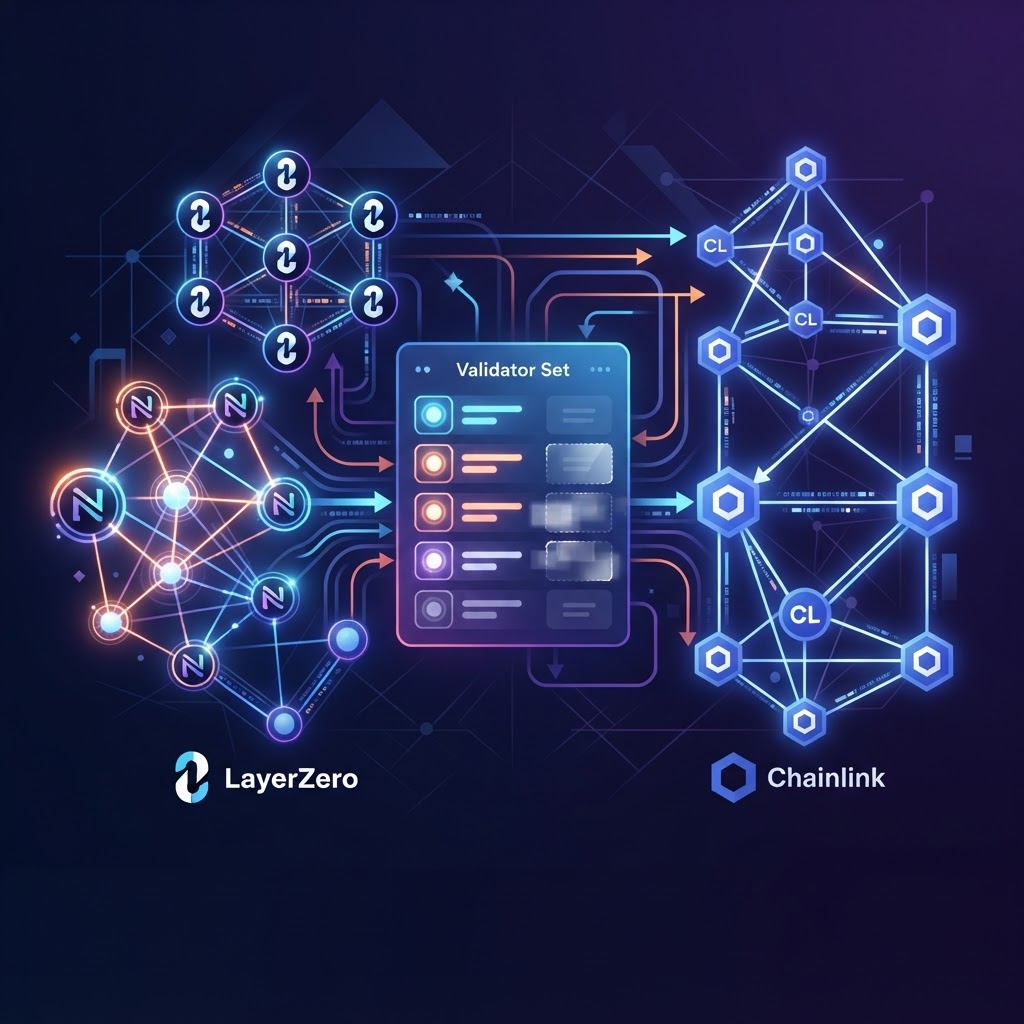
LayerZero is a cross-chain messaging protocol in which independent entities called DVNs (Decentralized Verifier Networks) verify the authenticity and integrity of messages moving between chains. Its distinguishing property is that the integrating application chooses which DVNs to use and how many. Security is not a property of the protocol; it is a configuration value set by the application.
Nethermind had operated a DVN since December 2023. The firm develops one of Ethereum's main execution clients, employs more than 200 people, and is reported to power 25–30% of Ethereum nodes. On 2026-08-19 it announced it had migrated away from DVN operations and joined the Chainlink Network as a node operator and strategic technology provider, helping secure CCIP and Data Feeds while also contributing tooling, infrastructure operations and integration support for developers.
The announcement describes the decision as following an extensive review, but the review has not been published, and no explanation was given for which technical or operational factors decided the outcome. Nethermind did not claim a flaw at LayerZero, and neither the cost nor the completion date of the migration was disclosed.
There is a sequence behind it. On 2026-04-18, 116,500 rsETH — about $292 million at the time (roughly ¥46.4 billion at USD/JPY 159, 2026-09-02) — was drained from Kelp DAO's rsETH bridge. Kelp had secured that bridge with a single verifier (1/1), LayerZero Labs' own DVN, rather than requiring agreement among multiple independent verifiers. After that incident, BitGo in August consolidated WBTC's cross-chain provision onto Chainlink, and the Wyoming Stable Token Commission moved the Frontier Stable Token to CCIP on 18 August. Publicly disclosed LayerZero-to-Chainlink migrations are reported to total roughly $15 billion (about ¥2.38 trillion). Nethermind's announcement came the next day.
What is actually at issue
What failed at Kelp was not the correctness of on-chain code. According to the reported sequence, on 2026-03-06 an attacker socially engineered a LayerZero Labs developer and harvested session keys that opened a path into the company's RPC cloud environment — a months-long infiltration of off-chain infrastructure. Funds were subsequently withdrawn through a call to a function on LayerZero's EndpointV2 contract.
LayerZero initially said the protocol had worked as intended and pointed to Kelp's choice of a single-verifier setup. On 9 May it reversed that position, saying it had made a mistake in allowing its own DVN to act as a 1/1 DVN for high-value transactions, and that it had not policed what its DVN was securing, creating a risk it did not see.
Two design points follow.
First, in a configurable-security model the default matters more than the maximum. A protocol may permit a 5/5 verifier configuration, but if most integrating applications run on the default at 1/1, the ecosystem's effective safety is set by the default. LayerZero acted on that reading, committing to move defaults to 5/5 where possible and no less than 3/3, and to stop approving messages for applications secured by only one verifier.
Second, DVN security is bounded by the operational security of the verifier operators. No amount of on-chain auditing detects a compromise of a verifier's key management or cloud environment. Yet which entities sit in the verifier set is invisible to the downstream contracts that depend on it. If the three verifiers present at integration time have become three different firms six months later, nothing changes on the contract side.
Trade-offs against the alternative, and distance to completion
Chainlink describes its own arrangement as secure by default, and Chainlink Labs Chief Business Officer Johann Eid called it a strong signal when an operator of Nethermind's calibre joins the network. Nethermind CEO Daniel Celeda framed the move as consistent with the firm's practice of making deliberate, long-term bets on the infrastructure it believes will define the next era of onchain finance. Both are statements from interested parties, not a verdict on technical merit.
The trade-off is real. A configurable model lets an application tune cost, latency and verification strength to its own risk tolerance. A fixed-default model reduces the room to misconfigure at the price of removing that tuning. Which is correct depends on the average sophistication of integrators. What Kelp demonstrated is that the assumption of the average integrator overriding the default and choosing an appropriate configuration did not hold.
Raising the verifier requirement also carries an availability cost. Requiring 5/5 means one operator going down stops that lane. Five operators then have to be sourced and retained per lane — and that sourcing gets harder once at least one prominent operator has chosen to leave. Strengthening verification and securing operators do not point the same way.
Nor is migration instantaneous. Nethermind said it would share updates throughout but gave no completion date. Because message format, fee model and finality handling all differ, moving to CCIP is not a drop-in replacement.
Pitfalls to watch
First, your application's DVN configuration is a per-lane setting. When an operator departs, a specified set may become unsatisfiable, producing an availability failure rather than a safety one. A configuration that names specific DVNs delegates your availability to those operators' business decisions.
Second, default changes do not apply retroactively. LayerZero committing to defaults of 3/3 or better does not necessarily change a deployed application that explicitly set 1/1. "The protocol changed its policy" and "our configuration changed" are separate facts.
Third, concentration in the destination is itself a risk. Roughly $15 billion of publicly disclosed value moving to one provider widens the blast radius of any outage or compromise at that provider. Diversity among messaging providers is itself a safety property.
Fourth, operator reputation is not a security property. In February 2026, security firm Octane Security used an AI auditing tool to find a high-severity bug in Nethermind's own Ethereum client that could have caused validators to miss rewards. Assembling well-known operators does not establish that key management and off-chain environments are adequately defended.
Fifth, Nethermind has not alleged a flaw at LayerZero. Circulating this migration internally as evidence that LayerZero is defective states more than the public record supports. What is verifiable is that the migration happened and that its timing coincides with a series of others.
[Technical Insights & Actions]
- In a messaging protocol with configurable security, effective safety is set by the configuration integrators actually chose and by the default — not by the strongest configuration the protocol permits. What an audit needs to check is not contract code but the number and identity of verifiers configured on that lane. This structure applies to every interoperability layer that externalises a verifier, guardian or oracle set, not just LayerZero. [Protocol integrators] During September, produce a per-lane inventory of every cross-chain route you use, listing the current verifier count, the named operators and the threshold, and confirm no 1/1 configuration remains. Any lane depending on a single named operator should be changed to list alternates.
- The verifier set is a trust assumption invisible from on-chain. If its composition has been swapped since integration, nothing changes for downstream contracts. Without a mechanism to detect changes in trust assumptions, risk moves silently. [Security / risk management] By next quarter, introduce monitoring that periodically retrieves and diffs the composition of verifier, oracle and guardian sets, and bring composition changes into the change-management process.
- Strengthening verification and preserving availability are two sides of one coin. A 5/5 requirement stops the lane when one operator goes down, and continued operator departures can stall the requirement itself on sourcing grounds. Setting a security requirement means simultaneously setting an availability target and a degraded-mode plan. [Architects / SRE] Before raising a verifier threshold, document the degraded-mode procedure for a stalled lane (pausing transfers, switching to an alternate route, notifying users) and review it in the same change as the threshold itself.
[Sources]
- The Block, "Ethereum engineering firm Nethermind leaves LayerZero verifier role for Chainlink" (2026-08-19): https://www.theblock.co/news/ecosystems/2026-08-19-nethermind-layerzero-chainlink-412226
- crypto.news, "Nethermind leaves LayerZero verifier role for Chainlink" (other migrations following the Kelp incident) (August 2026): https://crypto.news/nethermind-leaves-layerzero-verifier-role-chainlink/
- crypto.news, "$15B exodus: why crypto is leaving LayerZero for Chainlink" (migration totals and the significance of a DVN operator exit) (August 2026): https://crypto.news/layerzero-chainlink-exodus-15-billion-bridge-migration/
- CryIP, "Nethermind Leaves LayerZero to Become a Chainlink Node Operator" (LayerZero's 9 May statement, the off-chain intrusion sequence, and Octane Security's finding in the Nethermind client) (August 2026): https://cryip.co/nethermind-layerzero-chainlink-node-operator/
- CoinGabbar, "Chainlink News: Nethermind Joins" (statements from Daniel Celeda and Johann Eid; scope of the move) (August 2026): https://www.coingabbar.com/en/crypto-currency-news/chainlink-news-nethermind-white-house-link-etf-inflows
- Cryptonomist, "LayerZero Crypto Migration" (Wyoming Stable Token Commission migration date and the origin of the intrusion) (2026-08-20): https://en.cryptonomist.ch/2026/08/20/layerzero-crypto-migration-shift/
This article is a technical commentary based on publicly available information and is not investment advice.