
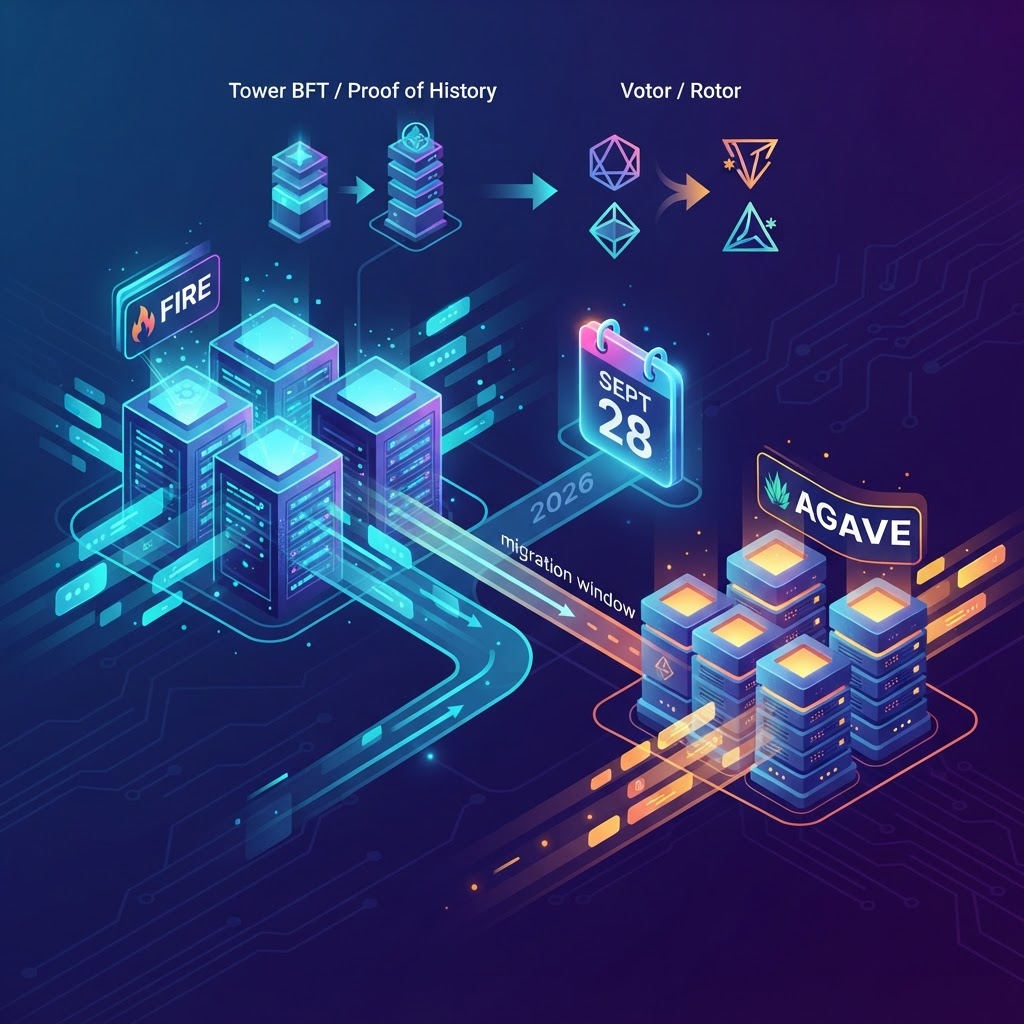
Solana sets 2026-09-28 for the start of Alpenglow feature activation — Firedancer will not cover the migration window, so operators must fall back to Agave
What happened
The Agave v4.3 release schedule, kept in the validator client wiki by Anza, carries a mainnet-beta row reading "Begin feature activation" with a target date of 2026-09-28. This is not an abandoned document: completed rows carry real delivery dates. The v4.3 branch was cut on 2026-08-11, it became the recommended release for testnet on 08-17, testnet feature activation completed on 08-19 and devnet on 08-24. Some rows landed ahead of their target dates, which is the strongest evidence that the table is actively maintained.
A second document supplies the subject. The Solana Foundation's release overview for Agave 4.2 states that Alpenglow is not activated in 4.2 and that activation is expected in 4.3, "targeted for October 2026". Only reading both documents together yields the claim that v4.3 contains Alpenglow and that its feature activation begins on 28 September. Read either alone and you get a date without a subject, or a subject without a date — which is precisely where aggregator sites and secondary coverage go wrong.
Note also that feature activation does not mean the network switches that day. Solana's feature gates take effect at an epoch boundary once enough stake is running the relevant version. 28 September is a starting point, not a completion point. "Alpenglow goes live on 28 September" is simply wrong.
The migration matters more than the spec
Alpenglow's design — Votor for voting, Rotor for propagation, replacing Tower BFT and PoH, targeting roughly 150ms finality — is already public, including the migration proposal in SIMD-0384. What bites in production is the "Alpenswitch": how a running network crosses over.
According to Chainflow's summary of validator discussions for 21–28 August 2026, Firedancer is expected to support Alpenglow from day one with one exception: it will not support the short live migration window. Operators are expected to switch temporarily to Agave for that period and move back afterwards. The window is described as a few thousand slots — at 400ms slots, 2,000 slots is about 13 minutes and 5,000 slots about 33 minutes. The stated reasoning is that supporting both the migration and Alpenglow would require additional engineering, audit and security work that the Firedancer team would rather spend on the full client. Related and now settled: the hybrid Frankendancer will be retired around Alpenglow activation, a question that was still open the week before.
This weight reflects how Solana's client mix has changed. What was effectively an Agave monoculture now includes Firedancer, live on mainnet since December 2025 and running roughly 14% of staked SOL by mid-2026, with a further 26% on Frankendancer. More clients means better resilience, but it also means operators must track which client implements which stage of any transition. Firedancer's decision here is likely to be the first significant case where client diversity translates directly into divergent runbooks.
Resource requirements are moving too. Firedancer's mainnet memory allocation is down to roughly 280 GB with further reductions planned; the September testnet release targets under 128 GB, enough to run on 128 GB testnet machines, while mainnet is expected closer to 200 GB. Releases now follow a monthly cadence with year-month naming — 26.08 has reached mainnet and 26.09 is next. Any migration rehearsal should record which monthly release it was performed against, or the rehearsed configuration will not match the one on the day.
There is also prerequisite work. Votor requires every participating validator to hold a BLS public key registered in its onchain vote account. Registration has been live on mainnet since the Agave 4.1 cycle under SIMD-0387 and requires Solana CLI v4.1.0 or later. Vote accounts without a registered key will not be admitted into consensus once the migration completes.
Slot times are shortening in parallel. The first step from 400ms to 350ms produced no visible problems across shred propagation, replay, execution or vote latency, and 300ms is scheduled to take effect at epoch 1024. Since an epoch is a fixed 432,000 slots, wall-clock epoch length falls from 48 hours at 400ms to 42 hours at 350ms and 36 hours at 300ms, while the 150-slot blockhash validity window narrows from 60 to 52.5 to 45 seconds.
Pitfalls to watch
There are three dates in play. 21 September appeared in discussions as the target for the mainnet release; 28 September is the start of feature activation; and "October" in the Foundation document is the expected activation period. Collapsing these into one figure for an internal update will misstate how much time you have.
For Firedancer operators the task is not an upgrade but a temporary move to a different client and back. A runbook that only covers binary updates leaves you improvising Agave startup, snapshots and key placement on the day. This needs rehearsal.
A missing BLS registration surfaces after the migration completes, as an inability to join consensus — not as a crash on the day. Monitoring that watches process liveness rather than vote participation will find out late.
Finally, the primary written source for these migration details is a third-party summary of validator discussions, not an official Anza runbook. Confirm against the official release notes and the current revision of SIMD-0384 before finalising an operational plan.
[Technical Insights & Actions]
- In large consensus changes, the failure mode is rarely the new protocol; it is the short window between old and new. In a multi-client network, whether to implement that window becomes a per-client decision, so client choice now determines the shape of your runbook. [Node operators] At least two weeks before 28 September, rehearse the full Firedancer-to-Agave switch and return on testnet, recording elapsed time and the rollback path if it fails.
- An "activation date" is usually a starting point, not a cutover. Where feature gates depend on stake share, you do not control when behaviour changes. [Integrators / product] From 28 September, monitor activation state per epoch and be able to verify finality-dependent logic — deposit confirmation, bridge confirmation counts — on both sides of the switch.
- A missing prerequisite registration shows up as quiet non-participation, not as an outage. Liveness monitoring will not catch it; you notice later, through rewards or participation rate. [Node operators] This week, inventory BLS public key registration across every vote account, register any gaps using Solana CLI v4.1.0 or later, and add vote participation rate to your alerting.
[Sources]
- Anza / Agave release schedule (validator client wiki, v4.3) (August 2026 onward): https://github.com/anza-xyz/agave/wiki
- Solana Foundation / Agave 4.2 release overview (2026-08-17): https://solana.com/news
- Solana Improvement Documents (SIMD-0384 migration, SIMD-0387 BLS key registration): https://github.com/solana-foundation/solana-improvement-documents
- Chainflow, "Summary of Solana Validator Discussions: August 21 - 28" (2026-08-28): https://chainflowsol.substack.com/p/summary-of-solana-validator-discussions-c79
- Chainflow, "Summary of Solana Validator Discussions: August 13 - 21" (2026-08-21): https://chainflowsol.substack.com/p/summary-of-solana-validator-discussions-9d1
This article is a technical commentary based on publicly available information and is not investment advice.