
Cronos Halts and Restarts Its Chain From a Pre-Exploit State After the Tectonic Attack — and the $6M That Could Not Be Rolled Back
What happened
Cronos Network halted the chain on 2026-08-30 after identifying an exploit at Tectonic. Tectonic is the largest lending protocol on Cronos; pre-exploit deposits are reported at roughly $121.7 million (about ¥19.35 billion at USD/JPY 159, 2026-09-02), around 46% of all capital deposited in Cronos DeFi.
According to on-chain researcher Weilin Li, who published the first trace, the attacker inflated the market price of Tectonic's governance token TONIC, posted the inflated position as collateral, and borrowed other assets from the pools. The manipulation completed within about twenty minutes, taking TONIC roughly a hundredfold higher. Tectonic's documentation lists a 20% collateral factor for TONIC in a parameter table dated May 2025.
Estimates of the amount borrowed vary. About $74 million (roughly ¥11.77 billion) is the most commonly reported figure, with estimates ranging from $66 million to $119.5 million. Only about $6 million (roughly ¥950 million) reached Ethereum before the chain stopped. One tally attributes $8.71 million in liquidations and $32.6 million of bad debt to the incident; that is a third-party figure and does not come from Cronos or Tectonic.
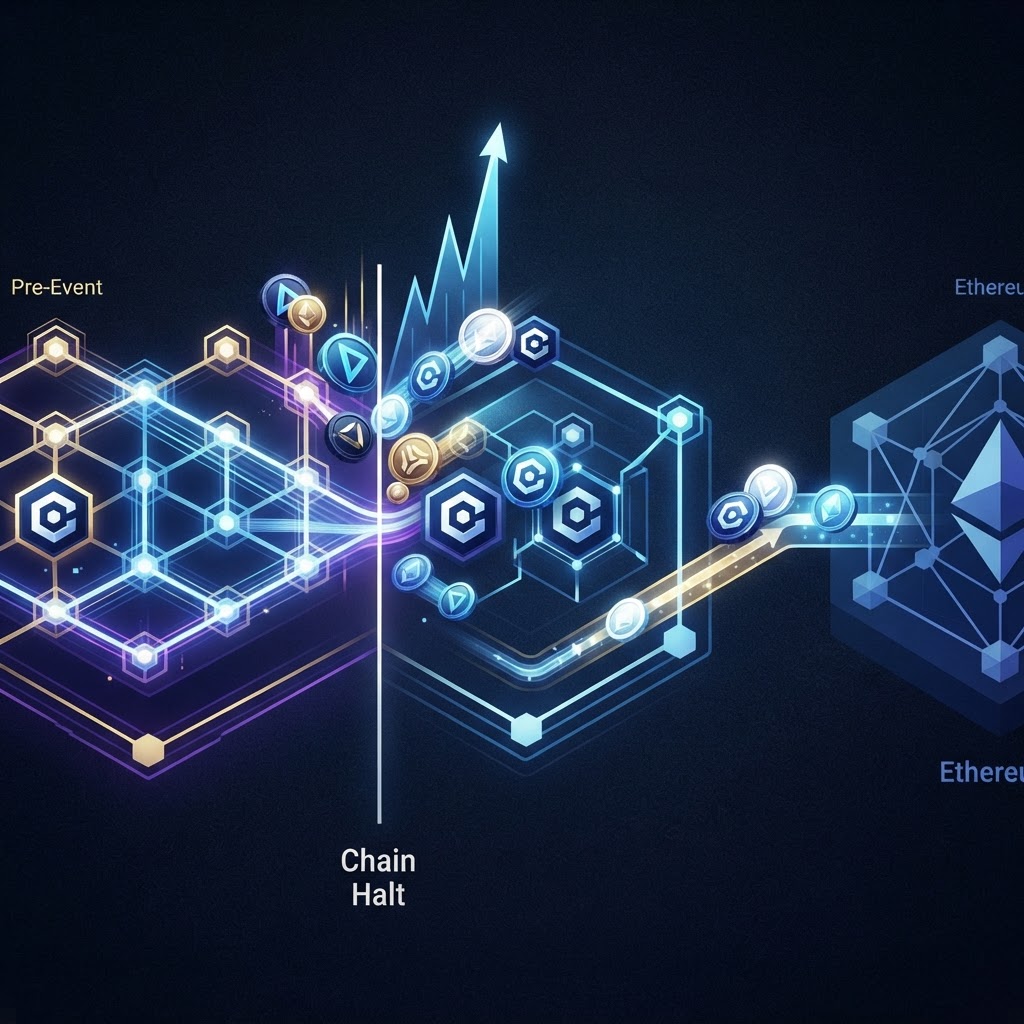
The chain produced no blocks for over ten hours. Validators then chose to restart from a snapshot taken before the exploit. The restart block is 90,896,189, timestamped 2026-08-30 23:49:01 UTC. Node operators were told to recover on Cronos v1.7.8 using snapshots published that morning. On 31 August Cronos described the halt as a validator-consensus emergency action and said the chain state had been restored to before that morning's Tectonic exploit, with the network fully back online — while noting that protocols, RPC providers, explorers and bridges built on top would take longer to recover than the base layer. Cronos has not published how many blocks were discarded; one media estimate puts it at roughly 11,000.
Crypto.com CEO Kris Marszalek said on 30 August that the company's app and exchange were not compromised and customer funds there were safe. A full post-mortem has been promised but had not appeared at time of writing.
The conditions, and the distance from comparable cases
Structurally the attack is not new. Make a price in a thin market, let the oracle that reads it pull collateral value away from reality, and borrow. It is the same shape as Mango Markets in October 2022 (roughly $100 million), and researchers have said so. The pattern recurred repeatedly in August: the previous week, Moonwell on Base lost about $8.7 million to MAMO price manipulation. Weilin Li called Tectonic the third such attack in recent weeks.
It recurs because the defensive design choice is legible in hindsight. A 20% collateral factor encodes an assumption that price can be wrong by up to a factor of five and principal survives. Against a hundredfold move it means nothing. The collateral factor is a parameter that presumes price accuracy; it is not a defence for when price breaks. What defends is a liquidity floor for tokens accepted as collateral, a per-asset borrow cap, and a circuit that suspends borrowing when a price feed moves abruptly.
The more consequential part is the response Cronos chose. Cronos is a Cosmos SDK chain, and Tendermint-family consensus advertises instant finality. Yet validator consensus discarded already-finalised history. This is a production demonstration that "finality," on such a chain, is a guarantee that a validator set can overwrite by social agreement rather than a cryptographic one.
The call can be defended as pragmatic — it preserved roughly $69 million for depositors. It also established a precedent that history is negotiable when enough validators agree. Both things are true.
Pitfalls to watch
First, a rollback does not cross chains. The roughly $6 million that reached Ethereum before the halt is not recovered by restoring Cronos state. Any bridge message that moved during that window is now "never happened" on the source side and "happened" on the destination side. The two ledgers diverge permanently. Bridge operators need to reconcile transfers processed in the discarded interval individually; automated reconciliation is not written on the assumption that one side's history has been deleted.
Second, if the published account is accurate, block heights have been reused. Restarting at 90,896,189 from a pre-exploit snapshot means heights from there onward previously existed with different contents. Implementations that cache results keyed on block height alone — indexers, accounting systems, exchange deposit confirmation — cannot detect that a different payload now occupies the same height. Without comparing block hashes, they will hold wrong data as if it were correct.
Third, this is not an ordinary reorg. A short chain was not replaced by a longer one through fork choice; the network restarted from a snapshot. Reorg-detection logic will most likely not fire. Monitoring built on "alert on a reorg deeper than N" walks straight past this event.
Fourth, as Cronos itself said, RPC providers and explorers recover after the base layer. Block heights and transaction histories fetched from RPC immediately after recovery may belong to the discarded branch. Confirming recovery from RPC responses alone risks treating deleted state as canonical.
Fifth, the same month saw MANTRA, TAC and KiiChain halt over a shared Cosmos EVM module vulnerability, which is unrelated to Tectonic. Summarising internally at the granularity of "several Cosmos chains stopped in August" merges two events with different causes. Record the reason for each halt separately.
[Technical Insights & Actions]
- On a haltable chain, "finality" can be overwritten by validator-set agreement rather than cryptography. No number of confirmations prevents this class of rollback. The only defence is waiting on the assumption that a rollback is possible — and that cannot be designed without knowing, per chain, who holds the power to halt. [Exchanges / custodians / integrators] By end of September, inventory every connected chain for who can decide a halt and whether a state restoration has ever been performed, and move deposit-finality policy on those chains from a confirmation count to a wait-time basis.
- A rollback's effect is contained within the chain; the damage is not. Wherever chains are connected, rolling back one side necessarily leaves the two ledgers inconsistent. This is not Cronos-specific — it applies to every combination of bridge and chain that keeps halt-and-restore as an option. [Bridge operators / protocol developers] Within two weeks of a recovery announcement, reconcile cross-chain messages processed during the discarded interval on both sides, identify transfers that completed on only one side, and document the manual settlement procedure.
- A snapshot restart is detected through a different path than a fork-choice reorg. Implementations that treat block height as a unique identifier are structurally unable to notice that contents have been replaced. [Data platform / indexer developers] By the next sprint, audit every persistence and cache layer keyed on block height alone, and change them to store the block hash alongside and re-ingest on mismatch.
[Sources]
- Cronos Network, official announcements of the halt and restart (2026-08-30 to 08-31), as reported by The Crypto Times: https://www.cryptotimes.io/2026/08/31/cronos-restarts-network-after-tectonic-exploit-and-rollback/
- CryptoSlate, "Cronos restart restores chain after Tectonic exploit" (restart block height and timestamp) (2026-09-01): https://cryptoslate.com/cronos-restart-after-tectonic-exploit-chain-rollback/
- The Defiant, "Cronos Produces No Block for 10 Hours as Tectonic Exploit Funds Sit Frozen" (separating this from the Cosmos EVM halts) (September 2026): https://thedefiant.io/news/hacks/cronos-produces-no-block-for-10-hours-as-68-7m-from-tectonic-exploit-sits-frozen
- The Crypto Times, "Cronos Halts Its Blockchain After Tectonic Exploit" (Weilin Li's analysis; TONIC collateral factor) (2026-08-31): https://www.cryptotimes.io/2026/08/31/cronos-halts-entire-blockchain-after-75m-tectonic-exploit-only-6m-escapes/
- TechEchelon, "Cronos Blockchain Halts and Restarts After $74 Million Tectonic Price-Manipulation Exploit" (quoting the Cronos statement) (2026-09-01): https://www.techechelon.com/post/cronos-blockchain-halts-and-restarts-after-74-million-tectonic-price-manipulation-exploit
- Coinpaper, PeckShield tally: 50 major hacks and about $136.3 million in August 2026 (2026-09-01): https://coinpaper.com/35120/crypto-hacks-hit-2026-record-with-50-attacks-as-losses-fall-49-to-136m
- AirdropAlert, third-party estimate of roughly 11,000 discarded blocks (September 2026): https://airdropalert.com/blogs/cronos-rollback-tectonic-exploit/
This article is a technical commentary based on publicly available information and is not investment advice.