
Solana Transaction V1 Raises the Size Ceiling From 1,232 to 4,096 Bytes — Opt-In to Send, Breaking to Read
What happened
A Solana transaction has always had to fit in 1,232 bytes, a figure derived conservatively from the 1,280-byte IPv6 minimum MTU to avoid fragmentation at the network layer. SIMD-0296 raises that ceiling to 4,096 bytes, and SIMD-0385 defines transaction v1, the message format that carries the larger payload. Both were authored by Anza engineers Jacob Creech and Andrew Fitzgerald.
The implementation ships in Agave v4.2.2 behind the feature gate txv1aq4pp281K9um3tnPgkfX8UqtFT6wcVW3hNezGLL. Local testing opened on 2026-08-24 with Solana CLI v4.2+ and Surfpool v1.5+, and the gate activated on testnet at epoch 1025 on 2026-09-01 (Anza's official account confirmed it at 22:19 UTC that day). Creech announced the 2026-09-09 mainnet date on X on 2026-08-29. That said, within the public sources available at the time of writing, the Solana Foundation's upgrade page still listed the feature as "Pending Feature Activation," and no official confirmation that the mainnet gate actually activated could be found. Operators should simply run solana feature status against their own node and read the gate state directly.
The ceiling moves from 1,232 to 4,096 bytes — a factor of roughly 3.32, or 2,864 additional bytes. One stated reason for choosing 4,096 is that 4 KB matches a common memory page size on validator hardware.
What the extra room is for, and what changes
That ceiling has always dictated what can live in a single transaction. Zero-knowledge proof payloads frequently do not fit in 1,232 bytes, and neither do large multisigs, aggregated BLS signatures or cross-chain operations. Developers had to split work across transactions or invent their own compression. Splitting sacrifices atomicity, which forces rollback handling into application code, and that has been a major source of complexity. The 4,096-byte ceiling is headroom to make those operations single atomic actions.
But v1 is not simply a superset of v0. The reported format differences are: the version byte is 0x81 (129 decimal) against 0x80 for v0; signatures sit at the end of the transaction rather than the front; the compute budget is carried in a header config mask rather than as instructions; and Address Lookup Table (ALT) support has been removed from v1. ALTs compress account lists, so their absence means that transactions referencing many accounts but carrying little data remain better served by v0. V1 is a format for large payloads, not a replacement for every case.
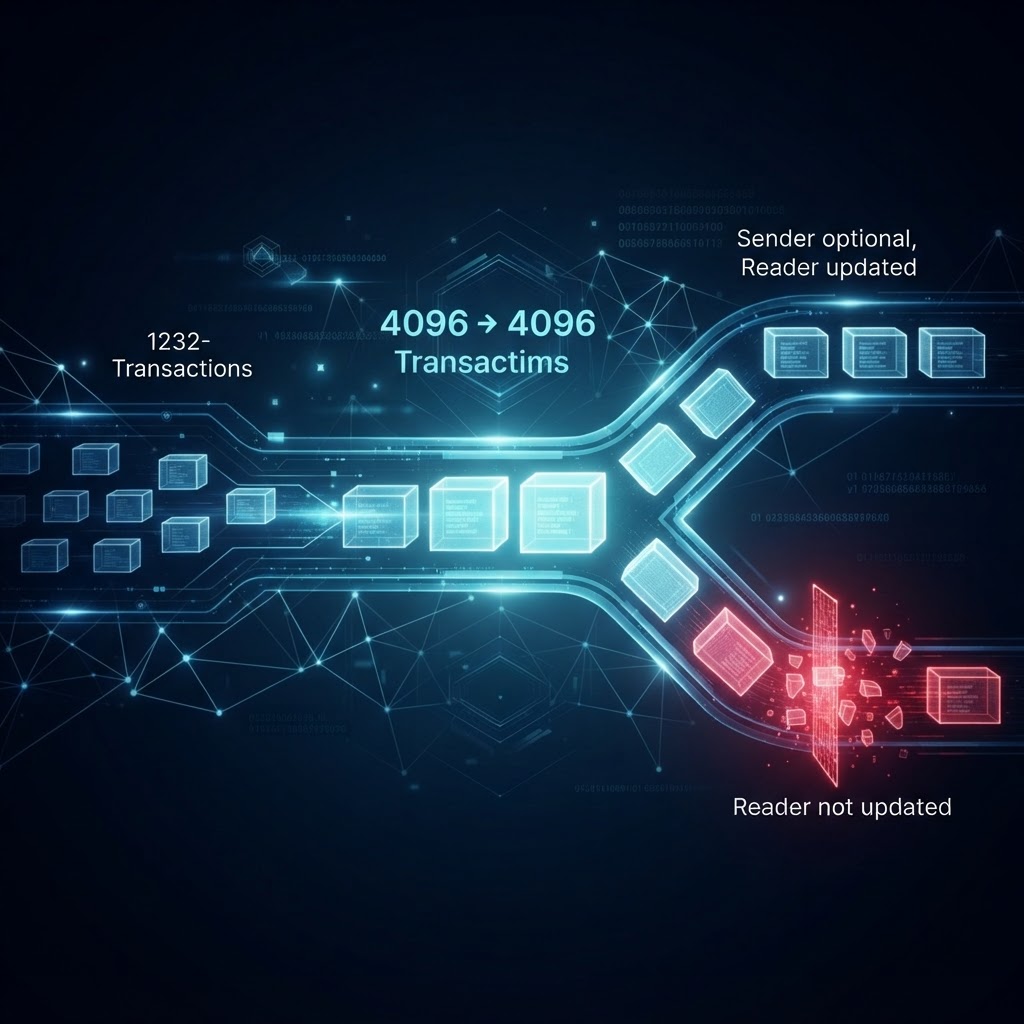
Legacy and v0 transactions keep working, still capped at 1,232 bytes. For senders, v1 is opt-in. For readers it is not: v1 transactions from other people land in blocks whether or not you use the format.
What raising the ceiling does at the network layer
The 1,232-byte figure guaranteed that a transaction fits in a single UDP packet. Derived from the 1,280-byte IPv6 minimum MTU less headers, it meant a transaction arrives anywhere without fragmentation — a property that kept Solana's ingestion and propagation path (QUIC intake, Turbine distribution) simple. A 4,096-byte ceiling removes that property. One transaction now spans multiple packets, so tolerance for loss and reordering moves up the stack into retransmission and reassembly.
As a design decision, that accepts complexity at the network layer in exchange for removing it from applications, which no longer have to split work and compensate for partial failure. It is a trade, not a one-sided improvement. The practical implication is that larger transactions may be likelier to be dropped during intake, so anything you put on v1 should be designed together with a retry strategy. The choice of 4,096 to match a 4 KB memory page is explained as simplifying buffer allocation along that path.
Pitfalls to watch
The sharpest edge is that RPC failures are not scoped to the offending transaction. If a call to getBlock omits maxSupportedTransactionVersion: 1 and the block contains even one v1 transaction, the entire call errors out — the other transactions do not come back either. getTransaction, and getTransactionsForAddress with transactionDetails = full, fail the same way. The returned JSON-RPC error code is -32015.
That error code doubles as a diagnostic for pre-existing breakage. If -32015 already appears in your logs, the project has been failing on v0 versioned transactions for some time.
A second trap is fixing the parameter without upgrading the SDK. Setting maxSupportedTransactionVersion: 1 achieves nothing if the installed SDK cannot decode the v1 layout. The published minimums are @solana/kit 8.0.0 (read and send), @solana/web3.js 1.x at 1.99.0-beta.0 (read only; it cannot build or send v1), and the Rust solana-* crates at 4.2.x (read and send). The correct order is to upgrade the SDK to a v1-capable release first, then set the parameter.
Anything that deserialises raw transaction bytes itself — a custom indexer, a signer, a relayer — is not rescued by an SDK bump. A decoder that does not handle version byte 0x81, trailing signatures and a header config mask will treat v1 as corrupt data, and the failure tends to be quiet: to a client written against the old schema, a v1 transaction simply looks incomplete or malformed.
Finally, this activation brings nothing else with it. The SIMD-0437 rent reduction, the staged slot-time reductions under SIMD-0525 (300 ms since epoch 1024 on 2026-08-28) and Alpenglow in October with Agave 4.3 each have their own activation process. Transaction V1 going live says nothing about any of them.
[Technical Insights & Actions]
- This change makes an asymmetry visible: readers do not get to choose the transaction format. Deciding not to adopt v1 does not protect your read path, because other people's usage lands in the blocks you parse. The same asymmetry recurs with every transaction-format or event-format extension on any chain. [Integrators / data platforms] Check the mainnet gate state with solana feature status today, and add a permanent CI test that fetches a block containing a v1 transaction.
- A design in which failure surfaces as a whole-call error rather than a skipped item leaves no room for partial degradation. Anything that fetches at block granularity needs refetch and alerting built for the worst case, where one unknown format stops everything. [Node operators / RPC providers] Within two weeks, add -32015 to log-monitoring alerts and grep historical logs for it; existing hits most likely mean data has been missing since v0.
- V1 is not a superset of v0. Without ALT support, account-heavy transactions are still better off on v0, which makes format selection an application design decision. A blanket "migrate everything to the newer format" policy is wrong here. [Contract developers / SDK consumers] Before your next release, classify your transactions as payload-heavy or account-reference-heavy, and write down a policy that puts only the former on v1.
[Sources]
- QuickNode, "How to Read and Send Solana v1 Transactions" (updated 2026-09-08; feature gate and format differences): https://www.quicknode.com/guides/solana-development/transactions/how-to-read-and-send-solana-v1-transactions
- Solana Compass, "Solana Transaction V1 Heads to Mainnet September 9" (2026-09-03; minimum SDK versions): https://solanacompass.com/news/solana-transaction-v1-heads-to-mainnet-september-9-format-breaking-changes-and-what-it-unlocks
- Solana Compass, "Transaction V1 activates on Solana testnet at epoch 1025" (2026-09-02): https://solanacompass.com/news/transaction-v1-activates-on-solana-testnet-at-epoch-1025-tripling-max-transaction-size
- Helius, "Agave 4.2 migration checklist" (RPC failure behaviour and -32015): https://www.helius.dev/blog/agave-4-2-migration-checklist
- Crypto Briefing, "Solana's Transaction V1 goes live on testnet" (2026-08-31; ALT removal and version byte): https://cryptobriefing.com/solana-transaction-v1-testnet-live/
- 24/7 Wall St., "Solana Activates Transaction V1 on September 9" (2026-09-08; Foundation page status): https://247wallst.com/investing/cryptocurrency/2026/09/08/solana-activates-transaction-v1-on-september-9-with-alpenglow-following-in-october-what-actually-changes/
This article is a technical commentary based on publicly available information and is not investment advice.