
EIP-8141 Moves to Scheduled for Inclusion in Hegotá — While Its Own Proponents Say Neither the Spec nor the EIP Number Is Settled
What happened
Hegotá is the network upgrade following Glamsterdam. With Glamsterdam pushed to Q4 2026, ethereum.org's roadmap places Hegotá in 2027.
Scoping is running in two phases. The first selected EIP-7805 (FOCIL, Fork-choice enforced Inclusion Lists) as the consensus-layer headliner. 6 August was the deadline for proposing non-headliner EIPs, after which the ACD process moved to assessing the upgrade as a whole. Researcher Toni Wahrstätter said on 16 August that 66 proposals were under discussion — which does not mean 66 approved features. Most sit at PFI (Proposed for Inclusion), a permissionless stage.
The 13 August ACDE agenda allotted roughly two weeks to narrow that field. The PFI list was expected to be finalised around 27 August, with proposals lacking a clear champion automatically deferred. Client teams are to submit ranked preferences by 10 September.
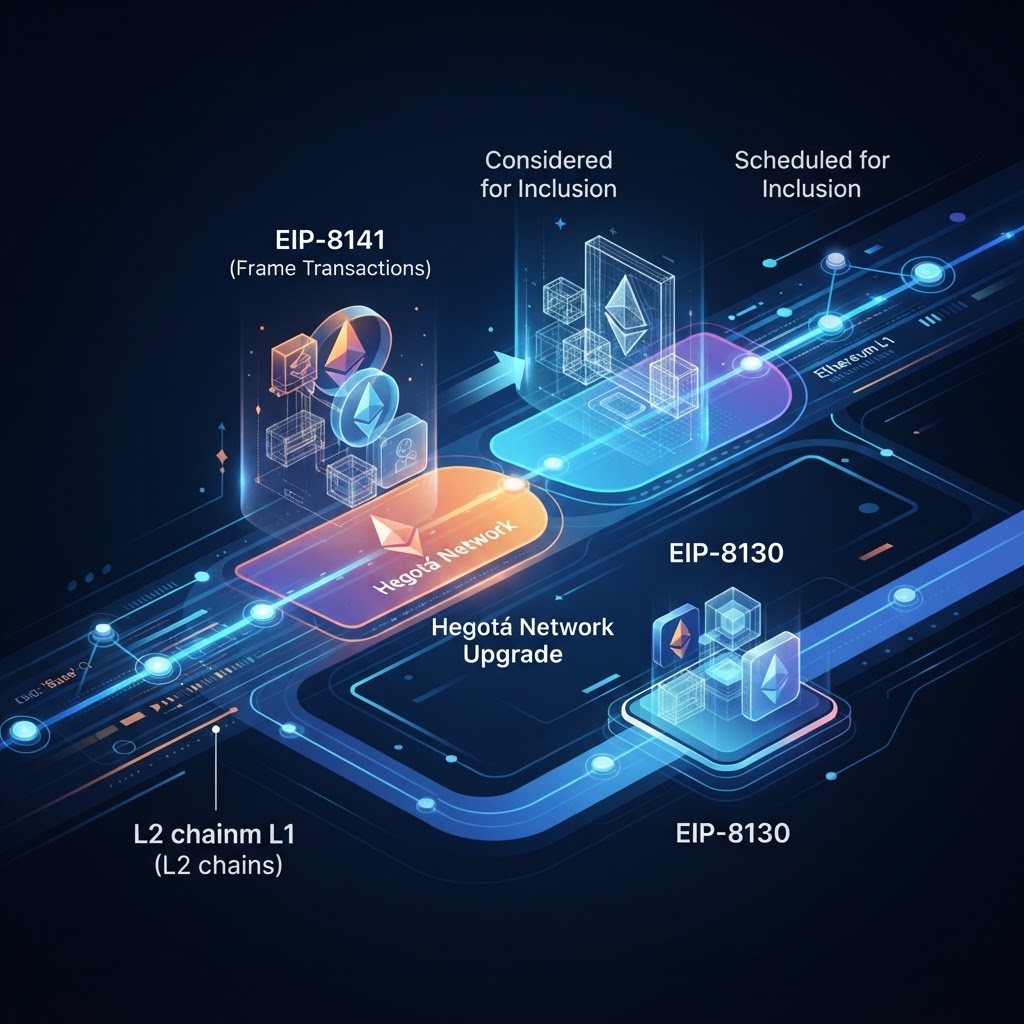
Against that backdrop, an account abstraction technical breakout on 25 August compared EIP-8141 and EIP-8130, and at the 27 August ACDE, EIP-8141 moved from CFI to SFI. Developer nixo.eth noted that the proposal had moved to Considered status in March of this year, and that there was strong consensus on the importance of shipping account abstraction in Hegotá.
EIP-8141, titled Frame Transactions, introduces a new transaction type that splits a transaction into a VERIFY frame and one or more EXECUTE frames, requiring nodes to simulate execution before mempool admission. Backward compatibility with existing EOAs is preserved: addresses do not change, and existing EIP-1559 transactions remain valid.
What problem it is trying to solve
Account abstraction itself is not new. ERC-4337 reached Final in March 2023, delivering it through an EntryPoint contract and bundlers without touching the consensus layer. EIP-7702, shipped in Pectra in 2025, lets an existing EOA temporarily delegate to contract code. By mid-2026, smart account deployments across Ethereum and its rollups are reported to exceed 30 million.
Enshrining it at L1 is nonetheless debated because leaving it at the application layer preserves fragmentation and limits composability. ERC-4337 UserOperations travel through a separate mempool and pay a premium for routing through EntryPoint — estimates put a UserOperation at roughly 30–50% more gas than the equivalent EOA transaction. Building it into the protocol removes both the premium and the second mempool.
The design focus of Frame Transactions is the explicit split between verification and execution. Allow arbitrary validation logic and you can no longer tell, at mempool admission time, whether a transaction can pay its fee — which is a denial-of-service surface. Separating a VERIFY frame and mandating simulation before admission restores that decidability. The trade is that node cost rises at the admission stage; validators will need to update client software, mempool policy and block selection logic.
Trade-offs against the alternative, and distance to implementation
Dissent from the same call is on the record. Ethlabs researcher Derek Chiang stated that the SFI for 8141 was only meant to signal that Ethereum will ship account abstraction in Hegotá, that it does not mean Frames as written — or even the final EIP number — is set in stone, and that he had argued in the ACDE against taking the SFI decision at that point, citing support for EIP-8130 and unresolved objections to Frame Transactions.
EIP-8130 is the proposal backed by Coinbase and Base, and is slated to go live on Base in September. An L2 will therefore implement an account abstraction scheme before L1 does. With Hegotá in 2027, the same address could behave differently on L1 and L2 for more than a year. To avoid that fragmentation, two paths are being weighed: merging the two proposals, or building 8130-style accounts on top of Frame Transactions so that an address behaves identically on both layers. Progress is tracked in the weekly AA breakout call (Tuesdays 14:00 UTC) and on the Forkcast dashboard.
On the wider Hegotá scoping, Ethlabs has put forward four priorities: FOCIL, shorter slot times, native account abstraction, and L1 scaling — the point being to avoid another overloaded hard fork. The group placed EIP-8182 (private ETH and ERC-20 transfers) in its lowest tier and recommended rejecting it for Hegotá, arguing it introduces zero-knowledge dependencies and should be treated as a headliner if pursued at all. On EIP-8375 (burning part of the gross value committed by selected external builder bids under ePBS), it warned the mechanism could encourage side-channel payments, noting that years of MEV-burn research have yet to produce a design with broad consensus. On EIP-8363 (burning a rising share of validator rewards as the staking ratio increases), Ethlabs declined to rank it at all, arguing monetary policy deserves broader debate rather than ordinary technical scoping.
A separate cluster addresses block growth as the gas limit rises. EIP-8131 charges a floor of 64 gas per user-controlled byte; EIP-8279 extends comparable accounting to Block Access List data; EIP-8368 would recalibrate state-growth pricing if the gas limit is raised beyond existing reference levels.
Pitfalls to watch
First, SFI declares "we will ship this feature," not "we will ship this specification." Here the proponents themselves have made the distinction explicit. Starting implementation against the current text of EIP-8141 risks a rewrite, number included. Tracking status labels alone hides that uncertainty.
Second, the L2 goes first. With 8130 live on Base in September, smart-account implementers have an economic reason to support 8130 regardless of what L1 adopts in 2027. If a merge does not materialise, the L1 specification will be settled after assets have already accumulated on the side of the earlier implementation.
Third, the 10 September submission is a set of client team preferences, not a decision. Reading inclusion in that list as adoption will diverge from the actual narrowing. Likewise, proposals that vanish from the PFI list at the 27 August cut may have lacked a champion rather than been rejected.
Fourth, Hegotá's scope is downstream of Glamsterdam's progress, and Glamsterdam has already slipped twice from the first half of 2026 to Q4. If the same scope-management failure repeats, 2027 moves too. It is early to treat 2027 as a fixed value in an internal roadmap.
[Technical Insights & Actions]
- Status labels (PFI / CFI / SFI) express strength of agreement, and are independent of how settled the specification is. This SFI is a statement of intent to ship a feature, not a spec freeze. Conflating the two axes leads to spending implementation effort against text that is still moving; internal tracking that follows status alone drops the distinction. [Tech leads / architects] Keep "status" and "specification stability" as two separate columns in internal protocol tracking, and for EIP-8141 stay at design review rather than implementation until the 10 September client preference results are in.
- When an L2 implements a feature before L1, the same address behaves differently by layer for an extended period. Applications that treat address behaviour under smart-account assumptions, and implicitly assume identical signing and validation logic across layers, break during that window. [Wallet and application developers] During September, while EIP-8130 goes live on Base, verify that your account abstraction code can branch on per-layer schemes, and introduce that branch point if your abstraction currently assumes a single scheme.
- Frame Transactions require simulation before mempool admission, pushing node cost forward to the admission stage. Reconciling arbitrary validation logic with mempool DoS resistance is the substance of this design. For RPC providers and anyone operating mempool monitoring, this is where Hegotá actually lands. [Node operators / RPC providers] Before the end of 2026, capture baseline measurements in the current environment for estimating admission-time simulation load (admission decision latency, rejection rate, simulation execution time) so a comparison basis exists.
[Sources]
- CoinDesk, "Ethereum core developers schedule EIP-8141 for Hegotá upgrade" (the 2026-08-27 ACDE SFI decision): https://coindesk.cc/ethereum-core-developers-schedule-eip-8141-for-hegota-upgrade-107338.html
- ETH Daily, "Account Abstraction Scheduled For Hegotá" (2026-08-27): https://ethdaily.io/account-abstraction-scheduled-for-hegota
- COINOTAG, on the SFI decision, Derek Chiang's objection, EIP-8130's Base launch and the AA breakout schedule (2026-08-28): https://en.coinotag.com/ethereum-core-developers-eip-8141-hegota-account-abstraction
- crypto.news, "Ethereum Hegotá plan gets 4 priorities from Ethlabs" (Ethlabs' assessments of EIP-8375, EIP-8182 and EIP-8363) (August 2026): https://crypto.news/ethereum-hegota-plan-gets-4-priorities-from-ethlabs/
- crypto.news, "Ethereum Hegotá narrows 2027 upgrade proposals" (the 66 proposals and FOCIL's status) (August 2026): https://crypto.news/ethereum-hegota-narrows-2027-upgrade-proposals/
- CryptoSlate / CryptoRank, on the ~27 August PFI cutoff and the 10 September client preference deadline (August 2026): https://cryptorank.io/news/feed/5088e-ethereums-next-major-upgrade-just-slipped-to-late-2026-forcing-a-two-week-scramble-to-save-its-2027-roadmap
- Everstake, on the VERIFY / EXECUTE frame structure of EIP-8141 and its validator impact (as of the March 2026 ACD call): https://everstake.one/resources/blog/native-account-abstraction-on-ethereum-what-eip-8141-means-for-validators
This article is a technical commentary based on publicly available information and is not investment advice.