
TAC's entire bonded staking pool emptied in one transaction — 28.6% of supply gone, twelve days halted, and the upstream patch had shipped three days earlier
What happened
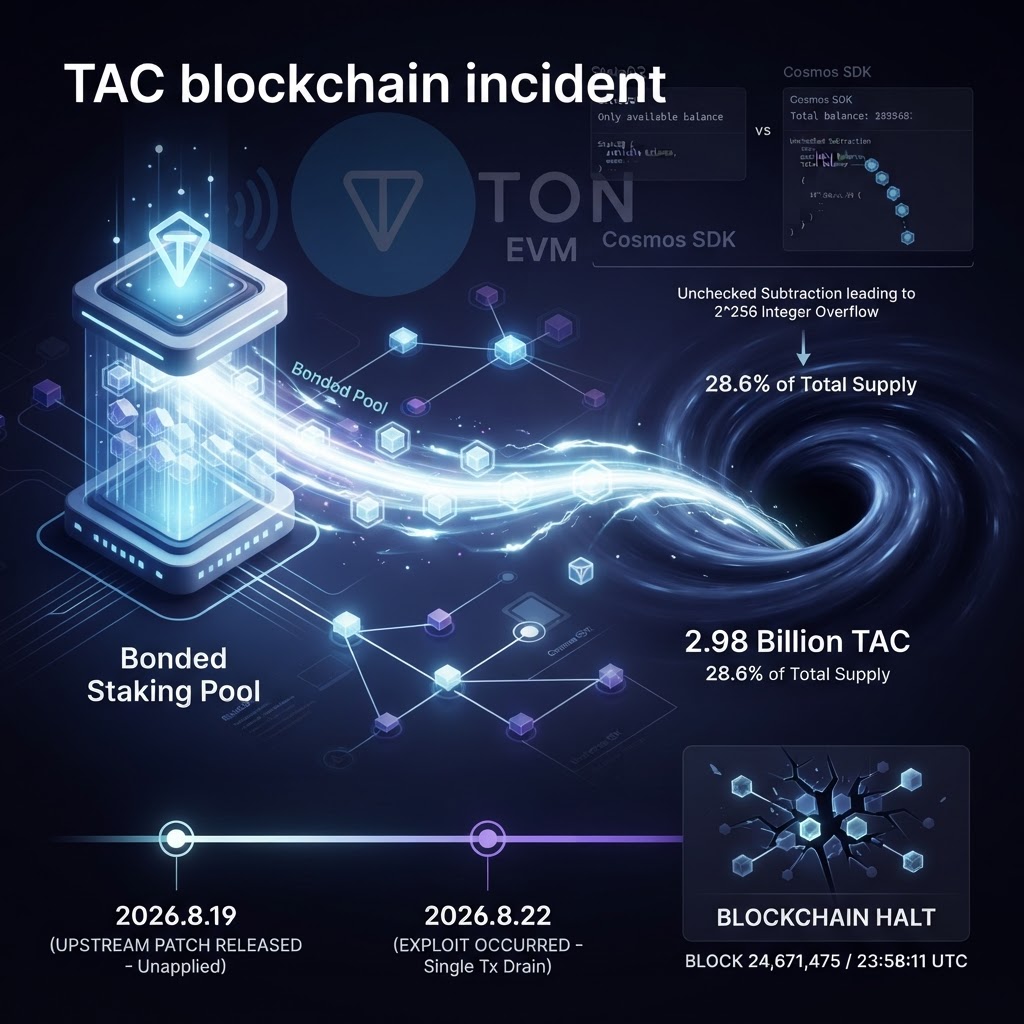
In a notice on 2026-08-22, TAC said a vulnerability affecting the Cosmos-based EVM side of the network had been exploited and that it was coordinating a temporary halt with validators, effective within minutes. The last block visible through the explorer API is height 24,671,475, timestamped 23:58:11 UTC that day. Normal block production had not resumed as of 4 September, putting the halt past twelve days. Bridging is disabled in both directions, so BNB Chain TAC cannot currently be redeemed against native tokens.
The post-mortem published on 1 September put the drain at 2,985,651,403.40 TAC, or 28.6% of supply — which implies a total supply of roughly 10.44 billion. TAC said a single transaction reduced the bonded pool to zero without changing total token supply. This was movement of existing tokens, not issuance. The result is a chain whose delegation records survive without the tokens that backed them.
What deserves attention is that monitoring worked and still did not catch it. TAC's bridge monitoring was designed to detect missing collateral behind mirrored tokens. The theft completed before the tokens reached the bridge, so the bridge's invariants held throughout. Large-transfer alerting was live, and the first bridge movement began just 32 seconds after the pool was emptied. Block production nonetheless stopped more than four hours after the drain.
The upstream defect and its disclosure timeline
The upstream Cosmos EVM advisory attributes the path to a mismatch between two balance records. The EVM StateDB tracked only an account's spendable tokens. The Cosmos SDK ledger additionally held locked vesting tokens that could be delegated. Delegating more than the spendable amount caused an unchecked subtraction to wrap toward a value close to 2^256 — a classic integer underflow, left in the layer that bridges two state models.
The timeline is the heavy part. Per Cosmos Labs' post-mortem, the bug reached the bounty programme on 25 April 2026, was patched on the main branch on 15 May and was backported into releases on 19 August: twenty days from report to main, ninety-six days from main to release. On 20 August a Push Chain fork publicly described the path, and TAC was attacked two days later. TAC separately says it sent a maintainer an analysis of two related defects in July without acknowledgement.
The lesson is that "fixed", "released" and "applied" are three different states. For a downstream chain running a shared module, a fix on upstream main confers no safety. Worse, publishing the backport is itself a notification to attackers — a patch diff points at the vulnerability, so the interval between release and downstream adoption is the exposure window. Here that window was three days.
How this differs from May, and what a state edit means
This is not TAC's first incident. A bridge breach on 11 May 2026 was documented in a 20 May post-mortem: the sequencer software failed to verify both the code hash of a TON jetton wallet and the expected minter behind it. Counterfeit deposit messages were accepted, unbacked equivalents were issued on TAC, and genuine assets locked on TON were released through the normal return path. Total protocol loss was put at approximately $2,854,486.22 as of 12 May (about ¥445 million at 1 USD = 156 JPY; rate from Trading Economics, 2026-09-03). That containment left the EVM layer running, unlike the full chain halt this time.
Two defects of different character surfacing in different layers within four months suggests something structural rather than a single bug. What they share is location: both sit where two worlds reconcile state.
TAC's proposed recovery is a state edit rather than a rollback. It would restore the bonded pool to its pre-incident balance, return delegators to their recorded positions, and remove the 65.1 million TAC frozen in attacker-linked addresses at the halt. The remaining market shortfall would be covered with approximately 1.258 billion TAC — about 42% of the drain — from the Foundation's treasury reserves, corresponding to the portion sold through BNB Chain and TON that cannot be removed onchain without reversing balances held by open-market buyers. TAC says the attacker sold 1,208,329,197 TAC on BNB Chain for 950,293 USDT (about ¥148 million at the same rate), with a further 1.662 billion TAC still in attacker-associated addresses.
A rollback rewinds agreed history; a state edit leaves history intact and rewrites specific balances. The second is narrower in blast radius but pushes legitimacy to the front: who may rewrite which balance, on what authority. Using treasury funds to preserve immutability is a defensible trade — but it is not a mechanism that scales if reserves run out. None of these steps is complete: validators must adopt the patched software, execute the edit and resume.
Pitfalls to watch
You cannot triage this by asking whether you run Cosmos EVM. The question is whether anything in your stack reconciles two or more state models — EVM balances against SDK balances, L1 against L2, onchain against an off-chain ledger. Mismatches surface at boundaries, not inside modules.
Monitoring can keep reporting "all clear". The bridge's backing check was satisfied throughout. Unless you write down which segment of the asset lifecycle each invariant protects, the gap is invisible.
A halt is containment, not resolution. TAC has been down more than twelve days with no restart date, freezing listings, bridges and applications, and adding a step ordinary incident response does not have: reaching consensus on a state edit. If your design includes an emergency stop, define in advance who decides to restart and how.
[Technical Insights & Actions]
- For a downstream chain on a shared module, "fixed upstream" is not a defence. Ninety-six days from main to backport, then three days from backport to attack, shows that patch publication doubles as a discovery mechanism for attackers. Upstream security advisories need to be tracked at commit level, not release-announcement level. [Node operators / protocol developers] This week, subscribe to security advisories and release notifications for every upstream repository your chain or nodes depend on, and define a target time from backport publication to your own deployment (for example, 72 hours) as an SLO.
- A monitoring invariant is silent outside the segment it guards. Backing-check bridge monitoring cannot detect theft that occurs before assets reach the bridge. [Infrastructure / security] By your next design review, map the asset lifecycle — issuance, delegation, transfer, bridge, redemption — and match each segment to the monitoring that covers it, so the uncovered segments become visible.
- An emergency halt buys time, and without a defined restart procedure the halt becomes the largest cost. Recovery by state edit is gated by validator consensus, not by technical feasibility. [Product / operations leads] This quarter, document degraded-mode operation for a prolonged halt of any chain you depend on — criteria for suspending deposits and withdrawals, customer communication, alternative routes — and plan for outages exceeding one week.
[Sources]
- CryptoSlate, "TAC network halt: Foundation pledges 1.26B-token fix" (2026-09-02): https://cryptoslate.com/tac-remains-frozen-for-over-10-days-after-a-massive-exploit-forces-a-1-26-billion-token-bailout/
- CryptoSlate, "EVM network halts block production after supply exploit as TON connection remains dark" (2026-08-24): https://cryptoslate.com/evm-network-halts-block-production-after-supply-exploit-as-ton-connection-remains-dark/
- Coindoo, "Blockchain Hack Drains 28.6% of TAC Supply From Staking Pool" (September 2026): https://coindoo.com/blockchain-hack-drains-28-6-of-tac-supply-from-staking-pool/
- Cosmos EVM security advisory / Cosmos Labs post-mortem (August 2026): https://github.com/cosmos/evm/security/advisories
- Trading Economics (USD/JPY, 2026-09-03): https://tradingeconomics.com/japan/currency
This article is a technical commentary based on publicly available information and is not investment advice.