
Three crates.io packages briefly poisoned — a plain cargo build was enough to run remote code, and Rust tooling across Solana and Ethereum sits in the blast radius
What happened
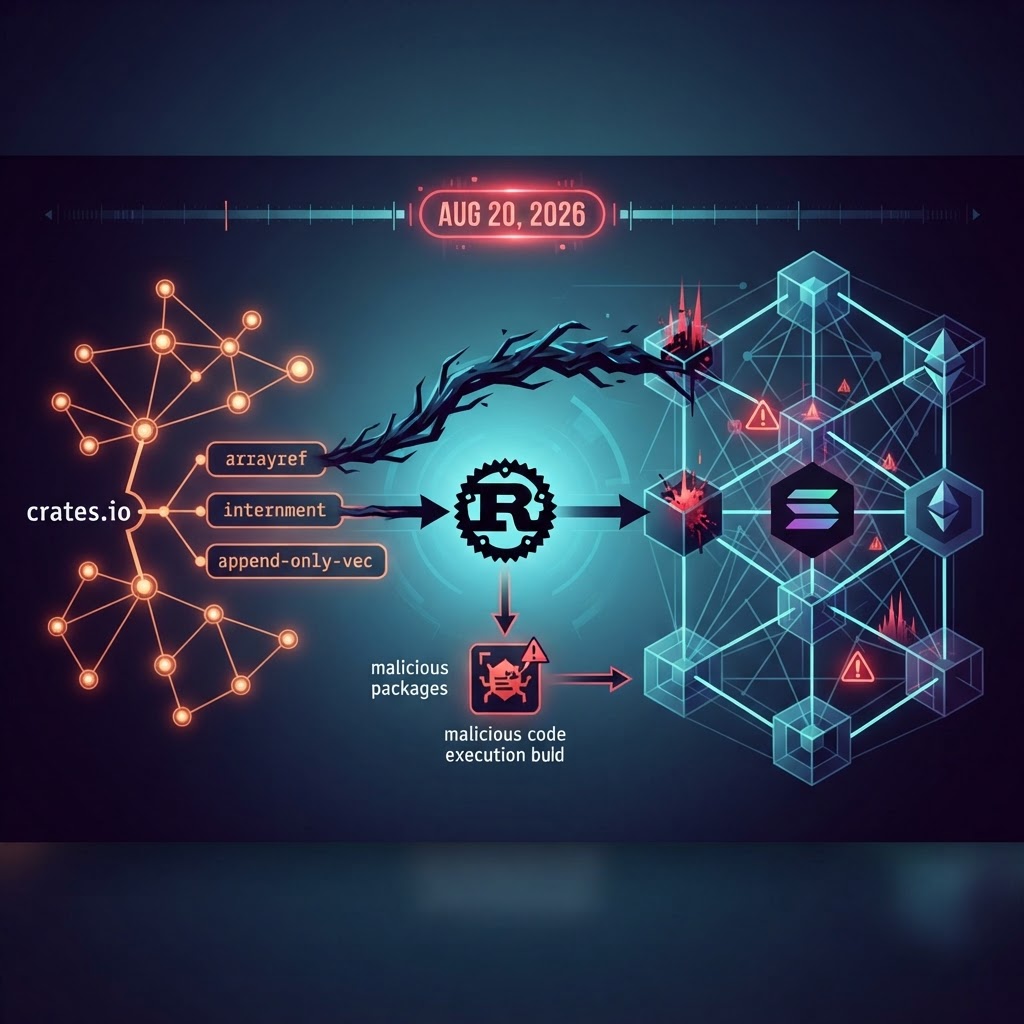
The Rust Security Response Team removed arrayref 0.3.10, internment 0.8.7 and append-only-vec 0.1.9 from crates.io on 2026-08-20 and locked the owning account as a precaution. All three came from the same owner. Rust's assessment is not that the maintainer acted maliciously, but that either their machine or their crates.io publishing credentials were compromised. The advisory was issued as RUSTSEC-2026-0260, and its wording has since been revised.
What the three legitimate crates had in common was a newly added dependency on proc-macro1 — a crate the attacker created, named to sit one character away from the widely used proc-macro2. The malicious code lived in proc-macro1's build script (build.rs), so it ran as soon as a build resolved to that version. Socket reports that its scanner flagged proc-macro1 at 07:29:50 UTC that day, when only arrayref 0.3.10 had been republished; the other two followed minutes later. Each malicious release was available for roughly 86 to 107 minutes. StepSecurity frames the campaign's overall exposure window as 07:11 to 09:25 UTC — two hours and fourteen minutes.
The attacker had a second dropper ready. proc-macro-en carried the same build script as proc-macro1, so removing one typosquat did not disarm the campaign. Four further attacker-owned crates — aovine, arone, aronenao and tinymember — were deleted in the same action. arone and aronenao were published on 2026-08-18, two days before the arrayref push, and Socket reads them as staging assets. The attacker also yanked several older legitimate arrayref releases, which would steer fresh dependency resolution toward the malicious 0.3.10. Rust later restored the legitimate versions.
Why this reaches blockchain infrastructure
arrayref is a small array-conversion utility with roughly 245 million lifetime downloads (some reports put the figure at 152 million just before the compromise; the number depends on the cut-off used). What matters is where it sits. arrayref lives underneath blake3 and winit, and it appears in the dependency graphs of both Solana and Ethereum toolchains. Wallets, validators, indexers and DeFi front ends — code built in environments that also hold keys and signing material — were in scope through transitive dependencies rather than direct ones.
The technical crux is what build.rs is for. Cargo build scripts exist so that crates can generate code or link against C libraries, which means running arbitrary code at build time is a supported, legitimate feature. An application never has to call a single function from a dependency for that dependency's build script to execute. The environment it executes in is a CI runner or a developer workstation, which is typically where signing keys, registry tokens and cloud credentials live. The reported payload reassembles its command-and-control address from base64 fragments and installs a custom certificate verifier whose methods return success unconditionally, disabling TLS validation. The usual audit question — did malicious code reach our production binary? — misses the point here. The target was the machine doing the building.
npm's postinstall hooks and PyPI's setup.py have produced the same class of incident for years, but in Rust the problem is sharper: build scripts are a normal, expected part of the ecosystem, so their mere presence carries no signal. That is a design trade-off, not a gap that can be closed quickly.
The detection path is worth noting too. Socket's scanner flagged proc-macro1 automatically and its follow-up analysis established the wider scope; separately, researchers at Nextron Systems reported the activity to the Rust Security Response Team, with technical detail disclosed through RustSec. SlowMist, Socket and StepSecurity all published in parallel — detection did not depend on a single channel. But all of it is post-publication detection. Establishing whether a payload actually ran in a given environment falls to that organisation's own logs. An early version of the RustSec advisory noted no evidence of use; that assessment rested on public download counts and the absence of reports, and the wording was later updated. That revision is itself a reason not to read an advisory once and move on.
Pitfalls to watch
Removal from the registry does not clean local state. A Cargo.lock that resolved to a malicious version, the ~/.cargo/registry cache, prebuilt container images and CI layer caches all survive the takedown. Running cargo update rewrites the lockfile; it does not undo a payload that already executed.
Looking at direct dependencies will not find it. In most projects arrayref is transitive and never appears in Cargo.toml. The artefacts to check are Cargo.lock and the CI logs for that window.
Yanking legitimate versions moves resolution. By pulling older arrayref releases, the attacker could steer projects that specify version ranges toward the malicious build. Pinned lockfiles were protected; setups that re-resolve on every CI run, and library projects that by convention do not commit a lockfile, were exposed directly. The habit of committing lockfiles only for applications deserves a second look on this evidence.
A short exposure window is not a safety argument. "No evidence of use" is an assessment drawn from public download statistics — it says nothing about whether a specific organisation's CI happened to build during those two hours. That evidence sits in your own logs.
[Technical Insights & Actions]
- A registry takedown stops distribution; it does not remove contamination. That upstream acted says nothing about the state of your lockfiles, caches and images. The same shape applies to npm, PyPI and container registries. [Node operators / infrastructure] This week, grep every repository's Cargo.lock for the three affected versions and review CI build logs and egress traffic for 07:00–10:00 UTC on 2026-08-20. Rotate credentials on any runner that matches.
- In ecosystems that permit build-time execution — Cargo's build.rs, npm's postinstall — the attack surface is dependency resolution, not dependency use. "We never call it" is not a defence. [Contract developers / tooling maintainers] By the next release, move CI builds onto a network with egress blocked and make --locked / --offline the default so nothing resolves outside the lockfile.
- One maintainer account, low in the dependency graph, is functionally write access to hundreds of downstream projects. This is not a property of one crate; it is a property of crypto infrastructure depending on shared public registries. [Product owners / security leads] Within the quarter, separate builds that handle keys and signing material from general developer CI, and evaluate an internal mirror that requires human review for dependency additions and updates.
[Sources]
- Rust Security Response Team / RustSec Advisory Database (RUSTSEC-2026-0260) (2026-08-20): https://rustsec.org/advisories/RUSTSEC-2026-0260.html
- Socket, "Popular Rust Crates Compromised in Build-Time Supply Chain Attack" (2026-08-20): https://socket.dev/blog/popular-rust-crates-compromised
- StepSecurity, "Rust Supply-Chain Attack: arrayref, internment, and append-only-vec Poisoned by the proc-macro1 Build-Time Dropper" (2026-08-20): https://www.stepsecurity.io/blog/arrayref-rust-crate-supply-chain-attack
- The Hacker News, "Rust Supply Chain Attack Puts Build-Time Malware in Crates with 245 Million Downloads" (August 2026): https://thehackernews.com/2026/08/rust-supply-chain-attack-puts-build.html
This article is a technical commentary based on publicly available information and is not investment advice.