
The Ethereum Foundation Graded All 62 Hegotá EIPs in a Single Tier List, With FOCIL (EIP-7805) the Only Unanimous S
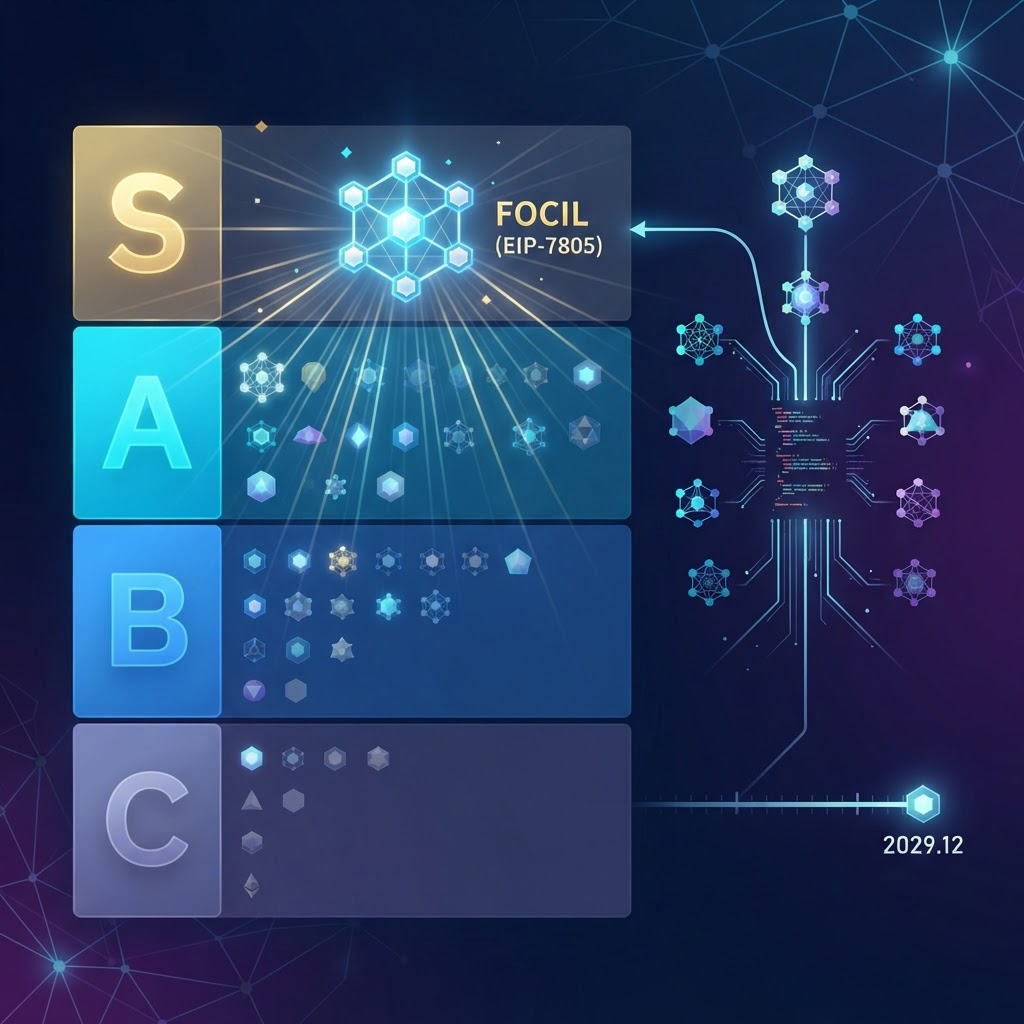
What happened
The EF Protocol cluster published two posts on 2026-09-07. The first, "The Hegotá EIP Opinion Post and Tier List," grades all 62 EIPs proposed for inclusion in Hegotá, each with a short note explaining the grade. The second, "Current and Emerging Priorities," lays out the cluster priorities and commitments that produced those grades. Hegotá is the upgrade following Glamsterdam and currently sits in 2027 on the public roadmap.
The significant change is the format rather than the content. Until now, client and research teams each published their own opinion posts on fork scope. This time nine teams within the cluster plus individual domain experts — about 60 people — spoke with a single voice. Geth, as an execution-layer client, will still publish its own standalone tier list; the unified post folds Geth's input and everyone else's in as data points rather than replacing client independence.
The scoring method is stated explicitly. Each contributor tiered each EIP independently, with S = 4, A = 3, B = 2, C = 1 and D/DFI (declined for inclusion) = 0. Averages count only cast grades, so an abstention never counts against a proposal. There were 397 grades in total, and contested items were discussed live before publication. The post is candid that each published tier is a steelman of the proposal.
What the grades actually commit to
The value here is not the ranking but the delivery commitment attached to each band. Per the post, an S means the feature defines the fork: scope holds and the schedule moves instead. An A is expected to ship and can only be cut once every S item is safely landed. B-tier proposals are admitted one at a time, most of them carrying three requirements — a prototype, a sign-off and a settled specification. C sits below the line, and DFI is a decline with a stated reason. A separate TBD band holds proposals until mainnet evidence from Glamsterdam can answer questions the cluster cannot answer today.
Only EIP-7805 (FOCIL) is reported to have taken a unanimous S at full participation. It lets any user get an eligible transaction included without depending on centralised builders, and is the locked-in consensus-layer headliner. On the execution side, EIP-8141 (Frame Transactions) is named as the other S-tier headliner. Secondary coverage reports 15 proposals expected to ship (S/A) and 28 declined (DFI), but the breakdowns published by different outlets do not sum to 62 — the exact distribution needs to be read off the original list.
The reasoning behind one decline is worth noting. EIP-8363 (Tapered Issuance Burn) was marked DFI not on technical merit but on process grounds: issuance policy touches every staker, holder and the network's long-run security budget, so a fork-scoping exercise is the wrong venue to decide it. That amounts to a declaration that fork selection stays a technical exercise and economic policy is routed elsewhere.
December 2029 as an external deadline
The hardest number in the companion post is the target date for making the base layer — execution, consensus and data — resistant to quantum attack: December 2029. Fredrik Svantes, who leads protocol coordination at the Foundation, has said the target shapes which proposals get recommended for Hegotá. Ethereum is not quantum resistant today; both account signatures and validator signatures rest on schemes that will eventually break. The work is split across accounts, validator signatures, consensus and proof systems.
The choice of date cannot be explained by internal considerations alone. Around 2029 coincides with migration targets set independently by Google, Cloudflare and Microsoft. Aligning internal prioritisation to an external cryptographic migration schedule is a signal that Ethereum is choosing to run on the industry's clock rather than its own — and that will outlast the tier list as a news item.
The trade-off in speaking with one voice
Collapsing per-team opinion posts into a single unified view has a clear benefit and a clear cost. The benefit is one reference point for proposers and outside observers. Previously you had to read several teams' posts against each other to infer what was actually favoured, and that inference cost fell hardest on the people championing proposals. A unified list gathers in one place which proposals move forward and under what conditions.
The cost is that minority views dissolve into an average. Scores are aggregated as means and abstentions are excluded, so a proposal that one team objects to strongly and a proposal everyone rates moderately can land in the same band. The post's insistence that each tier is a steelman, and that contested items were argued live before publication, reads as an acknowledged correction for that weakness. Still, reducing to a single number loses the intensity of dissent — which is exactly what Geth's continuing standalone tier list works against in practice.
There is an organisational dimension too. The EF went through a substantial restructuring in 2026 and has repositioned itself as one of many guardians rather than the primary one. Publishing a unified view in that context can be read as re-concentrating influence. The chosen format, though, leaves client independence intact and supplies only a reference point; on its own terms it stays on the informational side of the line rather than claiming decision rights.
Pitfalls to watch
First, this is not a governance decision. The tier list is the EF Protocol cluster's view; inclusion is decided separately through All Core Devs consensus and the fork's Meta EIP. Reading "S-tier, therefore shipping" conflates a proposal with an approval. Execution client teams were asked to submit their own rankings by 2026-09-10, and that aggregation is still ahead.
Second, the existence of a TBD band means part of the scope cannot be settled until Glamsterdam mainnet data exists. Glamsterdam's own activation date is unconfirmed as of this writing, so any slippage there propagates directly into Hegotá scoping.
Third, the published grades are written as steelmen. Since the post says so outright, reading a high grade as implementation maturity will mislead. The three requirements attached to B-tier items — prototype, sign-off, settled spec — being unmet is simply a statement that those proposals are still at design stage.
[Technical Insights & Actions]
- Because each grade now carries a schedule commitment (for an S, the date moves rather than the scope), the reasons a fork might slip are knowable in advance. You can plan on the assumption that trouble in an S-tier item delays the fork rather than dropping other features. [Product and technical strategy] At your next roadmap revision, tie dependency on Hegotá features to S/A items only, and strip firm dates from anything that depends on B-tier or below.
- The December 2029 post-quantum deadline is synchronised with external cryptographic migration schedules, not set by Ethereum's internal clock alone. Your own signature-dependent components — key management, signature verification, certificates, long-lived signed artefacts — fall on the same timeline. [Integrators / key management] Before year end, inventory the signatures and keys that must remain valid long term, and classify which of them require migration by 2029.
- Deliberately removing issuance policy from fork scoping means non-technical questions will be harder to introduce into fork debates going forward. If your implementation plan assumes a change to economic parameters, expect that change to move through a different process on a different timeline. [Validator operations / economic design] Before the AMA on 2026-09-16 at 14:00 UTC, identify the issuance and rewards proposals that affect you, confirm which process will decide them, and submit questions.
[Sources]
- Ethereum Foundation Blog, "EF Protocol: The Hegotá EIP Opinion Post and Tier List" (2026-09-07, note revised 2026-09-08): https://blog.ethereum.org/2026/09/07/protocol-hegota-eips
- Ethereum Foundation (@ethereumfndn), announcement (2026-09-07): https://x.com/ethereumfndn/status/2096976125511541198
- Cryptopolitan, "Ethereum Foundation grades all 62 Hegotá EIPs in first unified tier list" (2026-09-08): https://www.cryptopolitan.com/ethereum-foundation-grades-hegota-eips/
- Blockonomi, "Ethereum Foundation Rates 62 Proposals for Hegotá Upgrade" (2026-09-08): https://blockonomi.com/ethereum-foundation-rates-62-proposals-for-hegota-upgrade
- daily.dev, summary of scoring methodology and DFI rationale (2026-09): https://daily.dev/posts/ef-protocol-the-hegot-eip-opinion-post-and-tier-list-dyjtiipru
This article is a technical commentary based on publicly available information and is not investment advice.